

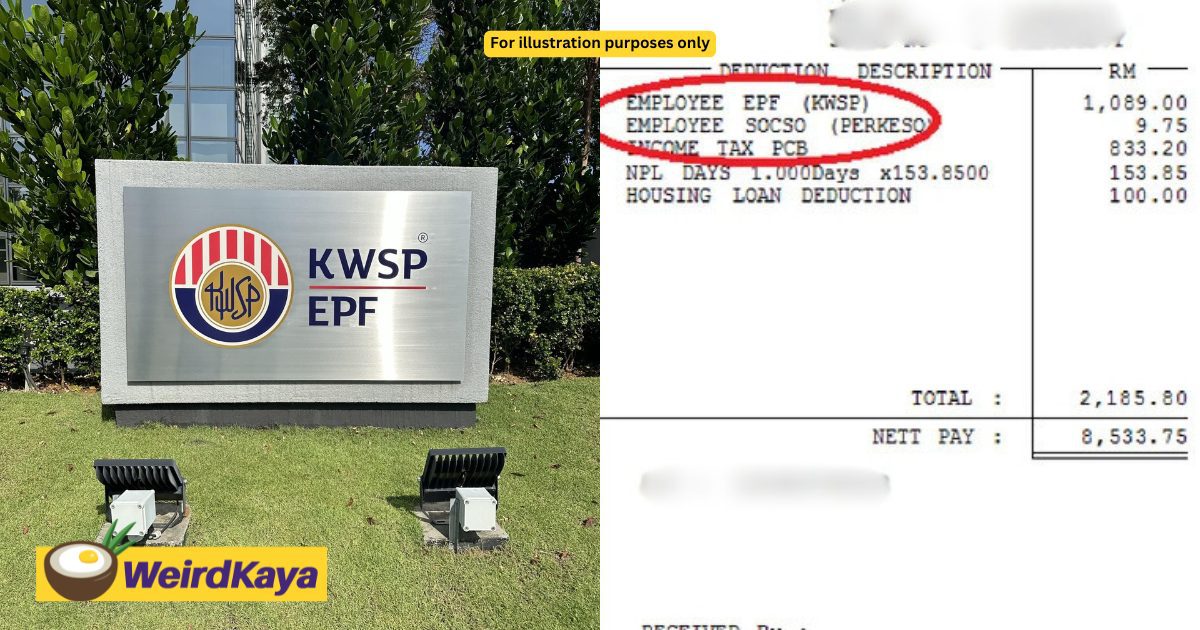
For many Malaysians, EPF or KWSP is something we see on our payslip every month, but not everyone fully understands how it works.
You receive your salary, notice a portion has been deducted, and your employer also contributes another amount into your EPF account.
But how much exactly should be deducted? Is EPF calculated based only on your basic salary, or does it include allowances too? And can your employer choose not to contribute EPF?
Here’s what employees in Malaysia should know, based on information from KWSP.
How much EPF is deducted from an employee’s salary?
According to KWSP, for Malaysian citizens and permanent residents below 60 years old, the employee’s EPF contribution is generally 11% of their monthly wages.

This amount is deducted from the employee’s salary and credited into their EPF account together with the employer’s contribution.
For example, if an employee earns RM3,000 a month, their employee EPF contribution would generally be around 11% of that wage.
However, employers are required to refer to the official EPF contribution table, especially for wages up to RM20,000, instead of simply calculating everything manually.
How much must employers contribute?
For Malaysian employees and permanent residents below 60 years old, the employer’s contribution depends on the employee’s monthly wage.
In general:
- Monthly wage RM5,000 and below: Employer contributes 13%
- Monthly wage above RM5,000: Employer contributes 12%
For employees aged 60 and above, the rate is different. According to KWSP, Malaysian employees aged 60 and above have an employee contribution rate of 0%, while the employer contributes 4%.
For non-Malaysian employees, the rate also differs. From October 2025 wages, non-Malaysian employees registered from 1 August 1998 are subject to 2% employee contribution and 2% employer contribution.
Is EPF calculated only from basic salary?

Not necessarily.
This is one of the most common misunderstandings among employees.
EPF is generally calculated based on “wages”, not just basic salary.
According to KWSP, payments that are liable for EPF contribution include:
- Salary or wages
- Bonuses
- Allowances
- Commissions
- Incentives
- Arrears of wages
- Wages for maternity leave
- Wages for study leave
- Payment for unutilised annual leave or medical leave
This means that if your allowance is part of your wage package, it may also be subject to EPF contribution.
For example, if your basic salary is RM3,000 and you receive a fixed monthly allowance of RM300, your EPF may be calculated based on RM3,300 instead of only RM3,000, depending on the type of allowance.
Are all allowances subject to EPF?
Not all allowances are treated the same.
KWSP lists allowance as one of the payments liable for EPF contribution. However, certain payments are generally not liable for EPF.
Payments that are generally not subject to EPF include:
- Overtime payment
- Service charge
- Gratuity
- Retirement benefit
- Retrenchment, temporary lay-off or termination benefit
- Travelling allowance or travel concession
- Payment in lieu of notice of termination of employment
- Director’s fee
In simple terms, fixed allowances that form part of your monthly wage are generally more likely to be included in EPF calculation.
However, payments that are more like reimbursements, travelling claims, or termination-related payments may be treated differently.
Can an employer refuse to contribute EPF?

No, an employer cannot simply refuse to contribute EPF if the employee is legally covered under KWSP rules.
According to KWSP, employers are responsible for making EPF contributions for employees under a contract of service or apprenticeship.
This can include:
- Permanent employees
- Part-time employees
- Employees on probation
- Employees contracted on a daily, monthly or annual basis
- Apprentices
Employers must pay both the employee’s share and the employer’s share to KWSP.
The employee’s share may be deducted from the employee’s wages, but the employer’s share must come from the employer.
In other words, your boss cannot say, “I don’t want to contribute EPF,” if the law requires them to do so.
Can an employer deduct their EPF share from your salary?
No.
This is important for employees to know.
An employer is not allowed to deduct the employer’s EPF contribution from the employee’s wages.
For example, if your employer is supposed to contribute 13%, that 13% must come from the employer.
It should not be taken from your salary on top of your own employee contribution.
When must employers pay EPF?
According to KWSP, employers must pay EPF contributions on or before the 15th day of the following month.
For example:
- January salary contribution must be paid by 15 February
- February salary contribution must be paid by 15 March
- March salary contribution must be paid by 15 April
If an employer pays late, fails to contribute, deducts EPF from the employee’s salary but does not pay it to KWSP, or contributes the wrong amount, the employee can lodge a complaint with KWSP.
What can happen if an employer does not contribute EPF?

Employers who fail to follow EPF rules can face legal action.
According to KWSP, employers may face penalties for offences such as:
- Failing to pay contributions by the 15th of the month
- Deducting the employee’s share but not paying it to KWSP
- Deducting or attempting to deduct the employer’s share from the employee’s salary
- Failing to register with KWSP
- Failing to register employees as EPF members
- Providing false statements or documents
For failure to pay contributions by the 15th of the month, an employer may face imprisonment of up to 3 years, a fine of up to RM10,000, or both.
If an employer deducts the employee’s share from their salary but fails to pay it to KWSP, the penalty can be more serious, with imprisonment of up to 6 years, a fine of up to RM20,000, or both.
What action can KWSP take against employers?
For outstanding EPF contributions, KWSP may take several actions against the employer.
These may include:
- Court action
- Bankruptcy action
- Seizure and sale of assets
- Winding-up proceedings
- Preventing company directors or business owners from leaving the country
This means EPF contribution is not just a “company policy” issue. It is a legal responsibility.
What should employees do if EPF is not paid?
Employees should regularly check their EPF contributions instead of only relying on their payslip.
You can check through:
- KWSP i-Akaun
- EPF statement
- KWSP app or portal
If there are missing contributions, wrong amounts, late payments, or deductions that were not credited into your EPF account, you can lodge a complaint with KWSP.
Employees should prepare documents such as:
- Personal details
- Employer’s name and address
- Employment contract, if any
- Period of employment
- Salary details
- Payslips showing EPF deductions
- Proof of salary payment
- Any other related documents
This can help KWSP investigate the matter more effectively.
So, what’s the simple takeaway?
Here’s the quick recap for employees:
- For most Malaysian employees below 60, the employee’s EPF contribution is generally 11% of their monthly wages.
- Employers generally contribute 13% if the employee’s monthly wage is RM5,000 and below, or 12% if the monthly wage is above RM5,000.
- EPF is not necessarily calculated based on basic salary only. Certain allowances, bonuses, commissions and incentives may also be included.
- Not every payment is subject to EPF. Items like overtime payment, travelling allowance, gratuity, retirement benefits and termination benefits are generally not liable for EPF contribution.
- Employers cannot simply refuse to contribute EPF if the employee is covered under KWSP rules.
- Employers also cannot deduct their own EPF share from the employee’s salary.
- EPF contributions must be paid by the 15th day of the following month.
- If your EPF is missing, late, wrongly calculated, or deducted from your salary but not credited into your EPF account, you can check your i-Akaun and lodge a complaint with KWSP.
At the end of the day, EPF is not just a small deduction on your payslip. It is part of your long-term savings, and employees have the right to know whether their contributions are being handled properly.
This article is based on information from KWSP’s official pages on mandatory EPF contribution, employer payment responsibilities, compliance and enforcement, as well as the EPF Act 1991.