Exclusive Story by WeirdKaya - Proper accreditation to WeirdKaya and consent from the interviewee are required.
For most people, standing in front of a full length mirror is an ordinary part of daily life.
But for 29-year-old Esther Ho, it was once something she quietly avoided.
Born with a complex congenital condition that affected her spine, legs, hearing and positioning of some of her internal organs, Esther spent much of her younger years struggling to accept the body she saw in the mirror.
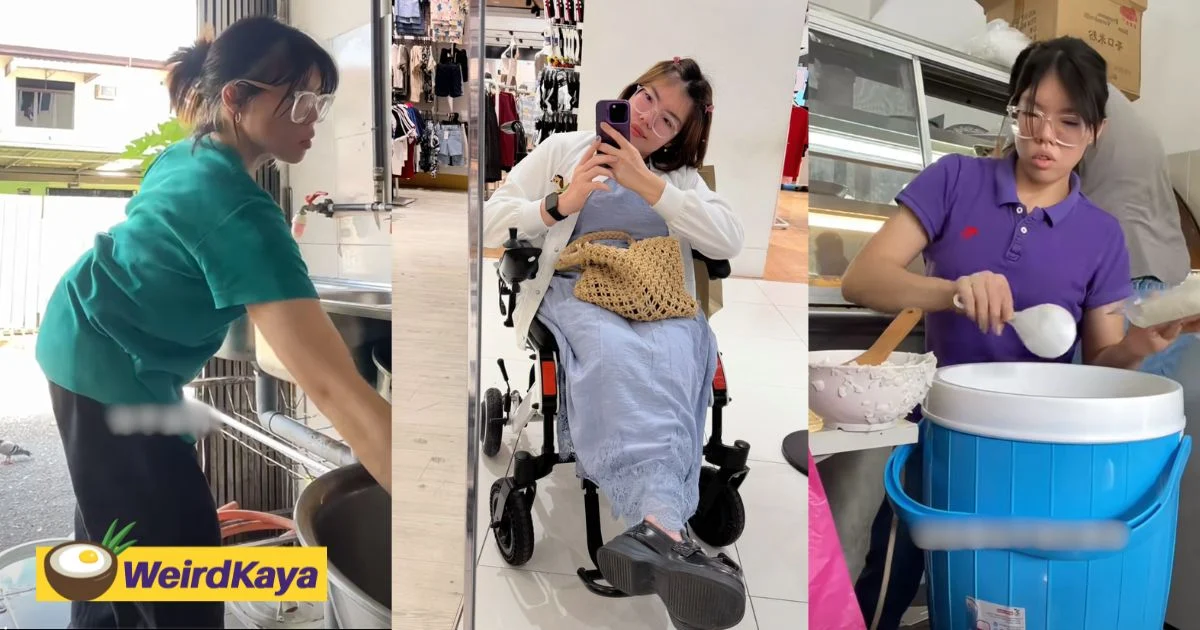
Today, she walks independently, works full-time as an admin, runs an online business, creates content, and even drives on her own.
However, getting here required Esther to confront not only her physical limitations, but also the fear and insecurity she had carried since childhood.

Family only learnt about her condition after she was born
Esther’s mother had diabetes during her pregnancy and was receiving insulin injections. It wasn’t until doctors noticed the foetus’ heartbeat was irregular, prompting an emergency delivery.
Three days after the delivery, Esther’s mother was finally able to get out of bed and saw her daughter for the very first time.
“When my mother first looked at my face, everything seemed fine. But when she opened the cloth covering my body, she almost fainted and kept crying,” Esther recalled.

This was because she was born with a severely curved and twisted spine, one Esther described as resembling a piece of clothing that had been wrung tightly. Her legs also developed differently, leaving her without a pair of functional knees. As a result, she cannot kneel or sit cross legged.
Esther is also unable to hear through her left ear, while the hearing in her other ear has also gradually declined over time.
Doctors once told her that the curve in her spine could potentially place pressure on her heart. and predicted she might not live beyond the age of 11.
Although it was only a prediction, it was something very frightening for my family.
“Despite their initial shock, my parents never treated my differently from my older brother and raised me just like any other child. They also never made me feel that I was less capable just because of my condition.”
Had to crawl and be carried to school
Although Esther is able to walk today, she could not do so independently during her early childhood.
Her legs were extremely thin and she had almost no physical balance. Before she learnt to walk, she moved around by crawling and was often carried by the family’s domestic helper when she went to school.
When Esther turned 10, her legs gradually gained more strength and she began falling less frequently and was eventually able to walk on flat surfaces without holding onto anything.
While walking on uneven ground or grass remains difficult, Esther and her family saw her progress as something they never expected to witness.
Despite her condition, Esther attended a mainstream school as her cognitive development was not affected by her physical condition.
“At first, some teachers thought I would be placed in a special education class. But my mind was completely fine and I could study together with everyone else.”
There were moments when other children made hurtful remarks, including comparing the way she moved to a monkey.
However, Esther said she was fortunate not to have experienced prolonged bullying.
“My classmates and teachers were actually very caring towards me. I’m thankful that I did not go through the kind of severe bullying that many children experience today.”
Growing insecurities
Although those around her did not deliberately exclude her, Esther began noticing her differences more clearly as she grew older.
Between the ages of 10 and 12, she became increasingly self conscious and often questioned why she could not do the same things as her friends.
“Other people could simply agree to go out when they were invited. For me, I had to consider whether the place was accessible and whether I could move around safely.

“That feeling was very frustrating. I kept asking myself, ‘Why me?’”
Due to difficulties with mobility, Esther left mainstream school at the age of 14 and switched to homeschooling. She eventually did not complete her formal education as academics were never something she enjoyed deeply.
What she did enjoy, however, was earning her own money.
At around 15 years old, Esther began selling products online through WeChat, where she worked as an agent, sourced items from Thailand and earned commissions from each sale.
The feeling of earning my own income gave me a lot of satisfaction. It made me realise that I was capable of doing business.”
Growing up, she also helped collect payments at her family’s coffee shop, which sold mixed rice, and later assisted with paperwork at her church.
Esther said her parents never pressured her to start earning at such a young age. Instead, it came from her own desire to cover her expenses and become independent.
Online work allowed her to hide from the camera
For years, online selling suited Esther because she could conduct business without showing herself publicly.
However, when the MCO affected her church work and income, Esther needed to look for more online opportunities.
In 2022, she entered the e-commerce industry and realised that appearing in videos and livestreams would help her reach more customers.
That was when she discovered that she had never fully accepted her physical appearance.
“I used to think I had already stepped out of my comfort zone. But when I had to show myself online, I realised that I was still very afraid of people seeing the real me,” she said.
Esther also recalled attending a piano class at a very young age that was held inside a dance studio filled with mirrors. Being surrounded by her own reflection made her deeply uncomfortable as she hated seeing her full body in the mirror at the time.
“I did not like what I saw. Sometimes, I even felt disgusted with myself. But with my livelihood depending on my ability to promote my business, I decided to confront the fear gradually.”
Esther started out by spending more time looking into the mirror before progressing to recording herself on her phone and appearing in videos and livestreams.
“At first, I did it because I needed to work. But the process also forced me to face the parts of myself I had never truly accepted.”
Today, Esther is comfortable speaking in front of the camera and openly shares her life as an OKU woman.
“What began as something I had to do for work eventually became something I enjoyed. I realised that I actually like recording my daily life and sharing my experiences.”

Health challenges
Last year, Esther was rushed to the hospital after experiencing a serious intestinal problem, where doctors discovered that some of her internal organs were positioned differently from that of most people.
After returning to Sarawak, she continued vomiting repeatedly and was forced to take a two month break to recover. Thankfully, her boss was understanding of her situation.
“My boss was very considerate and gave me the time I needed to rest. I am very grateful because employment opportunities for OKU individuals are honestly not easy to find.
“Eventually, they arranged for her to work from home, especially during my recovery period,” she said.
Esther believes Malaysia’s employment landscape remains challenging for OKU individuals.
She said some are capable of working but are often limited by inaccessible workplaces, a lack of flexible arrangements and employers who may hesitate to hire them.
Many people with spinal conditions may lose their mobility later in life. Apart from online work, there are still not many practical job opportunities available to them.
“I hope employers will look beyond a person’s disability and focus more on their skills, experience and ability to contribute.”
Getting a driver’s licence
Driving was another dream Esther had postponed for years, where she first considered learning to drive at 18, but could not find clear information about how an OKU person should begin the process.
She was also afraid of being alone and felt she did not have the ability to protect herself if something went wrong.
As Esther needed an adapted vehicle, the process involved additional visits, documents and arrangements. When she turned 28, she finally obtained her driver’s licence.
“For me, it was more than just being able to drive. I wanted the licence because of work and because I wanted to be more independent. I also wanted to prove to myself that I could do something I had been afraid of for so long.”

‘OKU individuals have their own way of living’
Esther knows that her life looks different from that of many others. However, she does not believe that being different automatically means being less meaningful.
She also does not want people to view OKU individuals only through stories of extraordinary success.
“OKU individuals have our own way of living, and we can still live exciting and meaningful lives,” she said.

Esther’s advice to others facing similar struggles is not to measure their future solely through their physical condition.
“Whether a person succeeds depends greatly on their mindset, their way of thinking and how they view the world.
“Do not give up too easily. Instead of always asking whether you can do something, ask yourself whether you truly want to do it.”
Exclusive Story by WeirdKaya – If you wish to reproduce this story, please ensure that you obtain consent from the interviewee to maintain factual accuracy and avoid the potential spread of misleading information.

If referencing or using any information from our story, we kindly ask that proper credit is given, along with a backlink to WeirdKaya, as acknowledgment of the efforts made by our editors in sourcing and conducting interviews.