

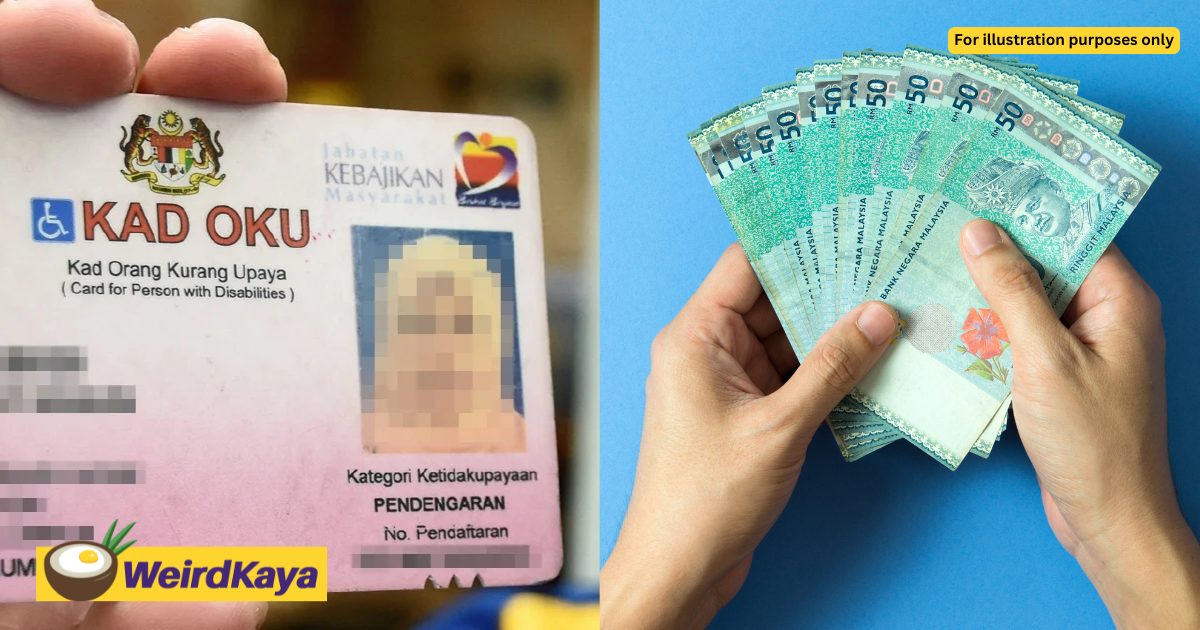
If you or someone in your family has a registered disability, the Kad OKU (issued by the Jabatan Kebajikan Masyarakat (JKM)) isn’t just an identification card; it’s the gateway to several monthly cash allowances that many eligible Malaysians still aren’t claiming.
Here’s a full breakdown of how much you can actually get, and exactly how to apply for the card in the first place.
The monthly allowances, broken down
JKM reviewed its assistance rates in 2026, and currently offers the following monthly allowances for OKU individuals and their caregivers:
1. Elaun Pekerja OKU (EPOKU) — RM450/month
For OKU individuals who are employed or self-employed. This is meant to encourage OKU to stay in the workforce and remain financially independent.
- Must be a Malaysian citizen, aged 16 and above
- Must hold a valid Kad OKU
- Monthly income must fall within the set threshold (generally RM100–RM1,700)
- If income later exceeds RM1,200–RM1,700 (depending on current guidelines), the allowance will be discontinued
2. Bantuan OKU Tidak Berupaya Bekerja (BTB) — RM300/month
For OKU individuals who are medically confirmed unable to work due to physical or mental disability.
- Requires confirmation from a government/private medical officer or a JKM officer’s investigation report
- Monthly income must not exceed the current Poverty Line Income (PGK) rate
- Applicants aged 60 and above who registered in 2024 or earlier are exempted from certain age conditions
3. Bantuan Penjagaan OKU Terlantar (BPT) — RM500/month
This one goes to the caregiver, not the OKU individual — paid to those caring full-time for a bedridden OKU or chronic patient.
- Household income must not exceed RM5,000/month
- One caregiver can receive this for more than one person under their care (rate depends on number of people cared for)
- If the bedridden patient has no eligible Malaysian caregiver, the aid can be approved under the patient’s own name
4. Geran Pelancaran — Up to RM2,700 (one-off)
A one-time launching grant for OKU individuals who want to start a small business.
5. Elaun Murid Berkeperluan Pendidikan Khas (EMBPK) — RM150/month
For OKU students enrolled in the Program Pendidikan Khas Integrasi (PPKI) at primary and secondary school level. Applied for by the school on the student’s behalf.
6. Bantuan Kewangan Pelajar OKU (BKOKU) — Up to RM3,100/student
For OKU students in public universities, polytechnics, or community colleges; covers tuition fees, living allowance, and special learning needs, subject to current allocation from the Ministry of Higher Education.
Important things to know
- EPOKU and BTB are mutually exclusive. You can only apply for one — whichever matches your work status. You can’t claim both at the same time.
- BPT is for the caregiver, not the OKU person being cared for.
- Payments are usually credited to your bank account in the first week of each month.
- All these allowances require an active, valid Kad OKU before you can apply.
- Rates are reviewed periodically, always confirm current figures via JKM’s monthly assistance page or by calling the JKM hotline at 03-8000 8000.
- On top of these monthly allowances, there’s also a tax relief boost: Budget 2026 introduced an additional RM10,000 tax relief for parents/caregivers of OKU children under 18, on top of the existing RM6,000 relief, claimable through LHDN.
How to apply for Kad OKU (step-by-step)
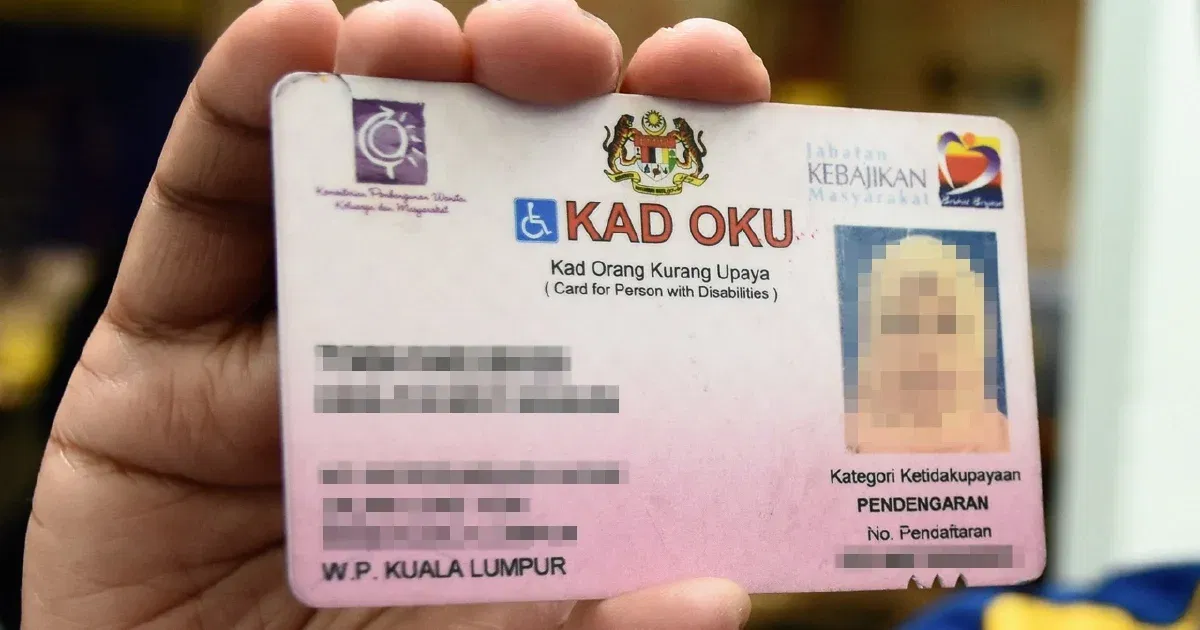
Before you can apply for any of the allowances above, you’ll need a valid Kad OKU. Here’s exactly how to get one.
Step 1: Get assessed by a doctor
Bring the individual (yourself, your child, or your elderly parent) to a doctor registered with the Malaysian Medical Council (MMC) or the National Specialist Register (NSR).
This can be a government or private doctor; what matters is that they’re properly registered. The doctor will assess the disability and confirm which category it falls under (physical, visual, hearing, learning, speech, mental, or multiple disabilities).
Exception: if the disability is visibly obvious (e.g. amputated limb, missing fingers/toes), you may be able to skip this and go straight to the JKM office with photo evidence instead.
Step 2: Get the registration form signed (BPPOKU / JKM18)
The doctor fills up and signs the official Borang Permohonan Pendaftaran OKU (BPPOKU), confirming the diagnosis. The form must be properly stamped; JKM will not process incomplete or unstamped forms.
Step 3: Prepare your supporting documents
You’ll typically need:
- Completed and signed BPPOKU form
- Copy of MyKad (or birth certificate/MyKid for children without MyKad yet)
- Passport-sized photo
- Relevant medical reports or specialist letters
- A copy of a recent utility bill (for some types of assistance applications, address verification may be required later)
Step 4: Submit your application
You have two options:
Option A — Apply Online via MyDaftar OKU
Go to MyDaftar OKU, part of the Sistem Maklumat Orang Kurang Upaya (SMOKU). Fill in:
- Bahagian A: Applicant’s biodata
- Bahagian C: Consent to release medical information
Upload your scanned documents and click submit.
Option B — Apply In Person
Bring your documents to:
- Your nearest Pejabat Kebajikan Masyarakat Daerah (district JKM office)
- Government hospitals or clinics
- Special education departments (for school-going children)
Step 5: Wait for approval
JKM will review your application and documents. Processing time varies:
- Online applications tend to move faster
- In-person/physical applications can take anywhere from one week to three months, depending on the office’s workload
You can check your application status anytime through the Semakan OKU portal — just key in your MyKad/MyKid number.
Step 6: Receive your Kad OKU
Once approved, JKM issues a digital OKU Card within 24 hours, delivered as a secure QR code that can be scanned at participating premises, public transport stations, and even e-hailing services.
If you’d prefer a physical card, you can still request one, though it’ll take longer to process and collect.
Step 7: Apply for the allowances separately
Having the Kad OKU does not automatically enrol you in any of the monthly allowances above; you’ll need to apply for each one separately:
- Visit your district JKM office within the stipulated timeframe (usually 14 days from when you’re notified) to submit allowance applications
- Bring required documents: MyKad, Kad OKU, payslip (for EPOKU) or medical report (for BTB/BPT)
- Approval typically takes 2–4 weeks
- First payment is usually credited the month after approval
If you think you or someone in your family might qualify, your nearest JKM office is the best place to start or you can reach out via JKM’s official contact page.
Note: Allowance rates, eligibility criteria, and processing times are subject to change based on current government allocations and budget announcements. Always confirm the latest figures with JKM before applying.