
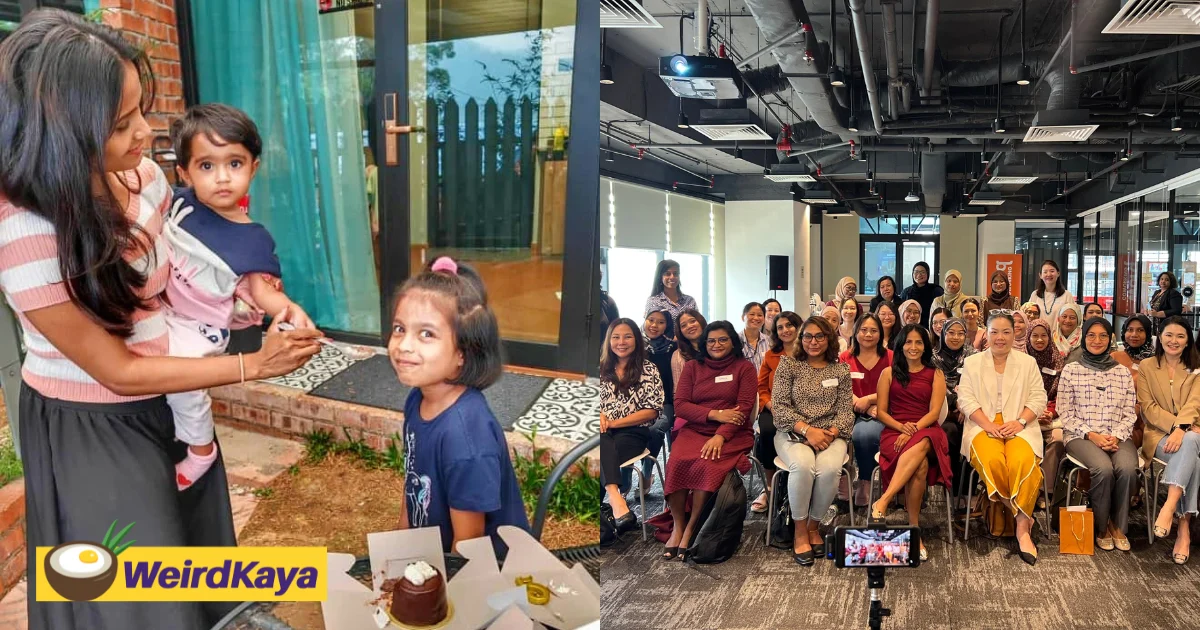
For many women, returning to work after motherhood is not just about finding a job. It is also about finding themselves again.
For 38-year-old Shalini Subramaniam from Sungai Siput, Perak, motherhood was not just a new chapter in life. It was also a season where she began questioning who she was outside of being a mother.
Before becoming a mum, Shalini’s career was a huge part of her identity. She left Malaysia at a young age to start her career in Singapore with an international oil and gas company, a move that taught her independence, resilience, and confidence.
I wasn’t afraid to take on challenges, and I genuinely believed that if I worked hard enough, I could build the life I wanted,” she told WeirdKaya.
At that point, her professional path felt clear. Promotions, learning opportunities, and career progression all seemed achievable. She described herself as intentional, independent, and “quietly ambitious”.
But motherhood changed the way she saw everything.
Feeling lost after motherhood

After leaving her corporate role, Shalini had her baby during the COVID-19 period and spent two years focusing on motherhood while running an online coaching business.
When she started thinking about returning to work, she expected herself to feel ready. Instead, she found herself struggling with self-doubt and the fear that she might fail if she went back into the corporate world.
My journey wasn’t a sudden leap, but more of a quiet, emotional shift that happened over time,” she shared.
Before motherhood, work felt straightforward. If she wanted to do well, she worked harder, stayed late when needed, took on more responsibilities, and focused on growing her career.
But after becoming a mother, things were no longer that simple.
“I would leave the office around 6pm, but instead of feeling accomplished, I felt guilty,” she recalled.
She felt guilty for not spending enough time with her daughter. But when she was at home, part of her mind was still thinking about work, deadlines, and everything waiting for her the next day.
It felt like she was constantly switching between two identities, employee and mother, yet never feeling like she was fully succeeding at either.
The mental load was overwhelming. Every day felt like a balancing act, and I was exhausted trying to keep everything together.”
The comment that hit her hard

For Shalini, one moment stayed with her deeply.
Someone, who she believes was well-meaning, once looked at her and said, “You studied so hard, you were always the high achiever… and what do you even do now?”
It was said casually, but it affected her deeply.
“In that moment, I realised that to the outside world, I had disappeared,” she said.
All the years she had spent studying engineering, living abroad, and building a career suddenly felt like they no longer counted in the eyes of others.
She was now seen only as “a mum”.
“And the worst part? For a brief moment, I believed them,” she said.
But that same moment also became the point where she decided she would no longer accept that narrative.
The fear many mothers quietly carry

When Shalini thought about returning to work, her biggest fear was not about whether she still had the skills or experience.
It was whether she could meet expectations at work while also being the mother she wanted to be.
She said many working mothers carry the pressure of being judged from both sides. At work, they worry about being seen as less committed. At home, they worry about not being present enough.
There was often a perception that working mothers were either not fully dedicated at work or not fully present at home,” she shared.
Looking back, Shalini said what she needed then was not just a job opportunity. She needed to see examples of women who had done it before.
“I wished I had role models, mentors, or a platform that could show me that it was possible to build a meaningful career while being a present mother.”
Realising other mothers felt the same

Through coaching and community work, Shalini began speaking to more women and noticed a similar pattern.
Many mothers questioned whether they were still relevant after being away from the workforce. They worried about their career gaps, whether their skills were outdated, and whether employers would see them as less committed because of family responsibilities.
But what stood out to Shalini was that these women had not lost their dreams.
They still wanted to contribute. They still wanted to grow. They still had ambition. They just needed someone to remind them of their value.
That was when Shalini realised the issue was bigger than helping mothers find jobs. They needed a support system, a community, role models, guidance, and a platform to help them rebuild their confidence.
Why mothers should have more options
Shalini also noticed that some mothers entered entrepreneurship not always because it was their dream, but because they felt it was the only option after becoming a mum.
To her, this reflected a bigger issue.
“Structured employment in Malaysia was not designed with mothers in mind,” she said.
Long hours, rigid schedules, limited flexibility, and the pressure to always be available can make it difficult for mothers to imagine returning to traditional employment. Some also fear that asking for flexibility or prioritising family commitments will make them appear less committed.
Because of that, entrepreneurship can feel attractive as it gives mothers a sense of control.
But Shalini believes it should not be the only path available.
Not every mother wants to start a business. Many mothers want meaningful careers, opportunities to grow, and the stability of employment.”
Starting Her Next Chapter

The turning point came from one question Shalini kept asking herself:
“What if mothers had the support system I wished I had when I was trying to figure out my next step?”
That question eventually led her to start Her Next Chapter, a platform created to help women reconnect with their confidence, learn new skills, meet role models, and explore new possibilities.
Whether a mother wants to return to employment, start a business, or create a different career path, Shalini wants women to know that their choices are not limited.
For me, Her Next Chapter is not just about helping women to be financially independent. It is about changing the narrative that motherhood slows down a woman’s ambition.”
A message to employers and society

Shalini hopes employers will stop seeing mothers returning to work as a risk.
Instead, she believes they should be seen as resilient, focused, and resourceful individuals who still have plenty to offer.
“The career gap on her resume is not a red flag. It is evidence that she is human, and that she made a choice,” she said.
She added that workplaces should move away from measuring commitment purely by long hours or constant availability, and focus more on outcomes, impact, and trust.
Flexible working arrangements, inclusive workplace policies, and supportive leadership can make a real difference in helping mothers thrive.
For Shalini, this is the change she hopes Her Next Chapter can contribute to, a future where women do not have to choose between being a great mother and having a meaningful career.
And to every mother who has ever felt lost after a career break, her message is simple: your ambition did not disappear. It may have simply been waiting for the right support, the right space, and the right chapter to begin again.
READ ALSO: