
Exclusive Story by WeirdKaya - Proper accreditation to WeirdKaya and consent from the interviewee are required.
For most teenagers, turning 18 means stepping into college, planning the future, and figuring out what life after SPM looks like.
But for Jet, a 27-year-old from Klang, that chapter of life looked very different.
At the age of 18, he underwent surgery for a brain tumour. What was meant to be a step towards recovery eventually left him with major physical challenges, affecting his vision, balance, facial muscles, and the right side of his body.
Today, Jet is disabled, but he is also a full-time NGO worker, a small business owner selling wellness tea, and someone who is slowly learning to live life at his own pace.

Growing up happy and active
Before everything changed, Jet described himself as an active teenager who loved trying new things.
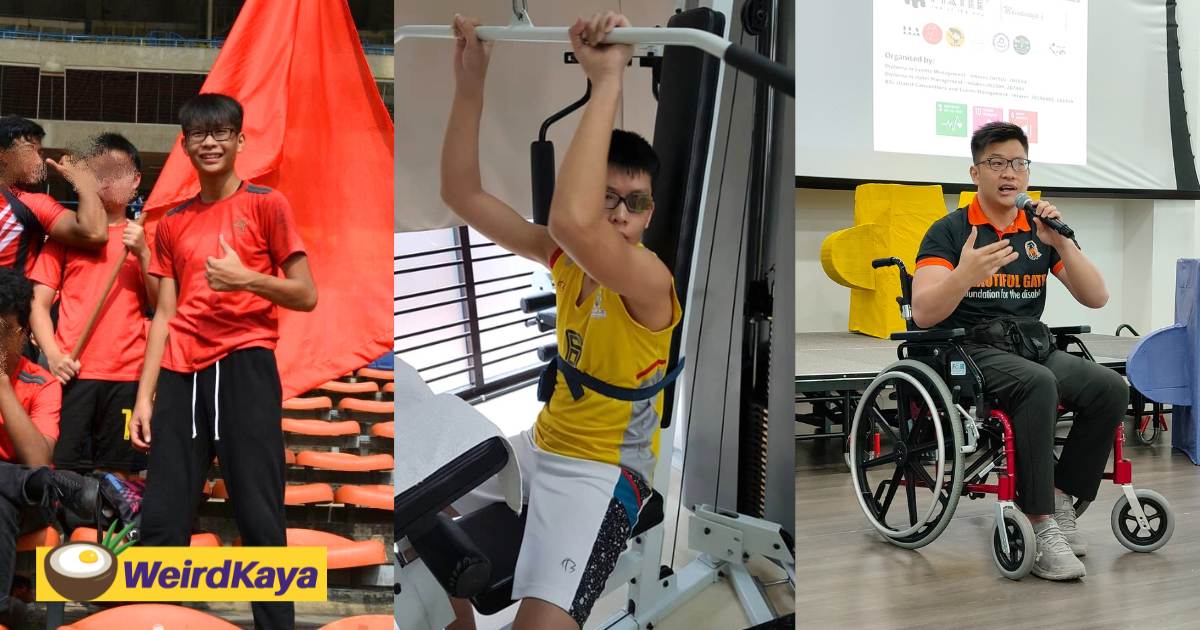
He enjoyed sports, especially basketball, and was part of the school team. He was also active in marching activities and even served as a commander for the red team.

However, studying was never really his main interest.
“I didn’t really have a big dream back then. I just liked moving around and experiencing new things,” he recalled.

At 17, Jet first experienced a strange symptom when the left side of his face became partially paralysed and a friend encouraged him to get it checked.
And that was when he found out he had a brain tumour.
At first, Jet and his family did not immediately decide on undergoing surgery. But while preparing for SPM, his hands and legs started to feel numb as the tumour began affecting other nerves in his body.

Despite the worrying diagnosis, Jet said he was still quite innocent and positive at the time.
When the SPM English essay question asked what he wanted to do after graduation, he even included his brain tumour and upcoming surgery in his answer.
I was quite positive as I thought after the surgery, I would slowly recover. My family, however, was extremely worried.
“To me, surgery simply felt like something I had to go through. But in reality, it would mark the beginning of a long and difficult journey,” he said.
Lifechanging surgery
The next year, Jet went for surgery and found himself adopting a routine that was starkly different from that of his peers.
Instead of attending classes, he spent his days going through physiotherapy and recovery as the surgery had affected him from head to toe.
He experienced facial paralysis, weak eye muscles, blurred vision, and difficulty seeing clearly. The right side of his body, including his arm and leg, also became numb.

Although his limbs still had strength and movement, Jet lost his sense of balance and had to rely on a wheelchair. During the early stage of recovery, he could not even sit up properly.
“For the first one and a half years, I couldn’t really sit up. I was mostly at home and people would come over to provide therapy,” he said.
Throughout the difficult period, Jet said his family and friends played a huge role in supporting him. His classmates also visited him after the surgery, which gave him much needed encouragement
But one of the biggest sacrifices came from his mother.
“Before my surgery, my mother had a stable career and was earning a considerable income. However, she made major adjustments to care for me and bring me for treatment due to my condition.
“Although I don’t describe myself as an overly emotional person, one of my biggest worries was whether I would become a burden to my family,” he admitted.

Readjusting
For someone who used to be active and loved sports, recovery wasn’t just physically difficult, but emotionally painful too.
For someone who used to love basketball, one of the most heartbreaking moments came during physiotherapy.
“I recalled the time when I was asked to simply pat a basketball, something that once felt so natural to me as a former school team player. But after the surgery, even that simple movement became difficult.
That time I really broke down. Basketball used to be something I loved and could do easily. But suddenly, even patting the ball felt so hard.”

Jet’s vision also affected his daily life. His eyes would shake, making it hard to focus. Sometimes, his vision would appear blurry, making it a struggle to differentiate depth and distance.
He added that even stairs could be difficult to identify if there was no clear colour contrast.
After the surgery, Jet admitted that he often compared himself to people around his age as he felt he was being left behind in life by his condition.
“But when I turned 22, I began to focus more on myself instead of constantly looking at other people’s lives and started reading, exercising, building discipline, and working on his mindset.
“I realised everyone has their own speed. I just needed to focus on myself,” he said.
Helping the disabled community
Today, Jet works full-time at an NGO that serves the disabled community, where he has faithfully worked for three years and earns a stable income.
His job includes helping disabled individuals arrange transportation for hospital trips, apply for welfare aid, access support such as the EPC allowance, and getting involved in CSR activities and advocacy work.
For Jet, one of the most meaningful parts of the job is being able to meet and communicate with different people.
“I like that I get to interact with people through NGO work. It has helped me gain independence and showed that I’m still capable of contributing to society.”

Selling wellness tea
Apart from his NGO work, Jet recently started a small side business selling wellness tea for the past three months.
Jet said the idea came from wanting to explore more opportunities, increase his income, and give his family a better life.
Most importantly, he did not want to remain in a state where he felt like a burden.
“I chose wellness tea because I felt it was something suitable for many people, from children to the elderly, and could promote better health.

“The business is run together with a friend, who handles the accounts, records, and back-end matters, while I focus on sales, product promotion, social media, and setting up booths at markets.”
When Jet first joined a market as a vendor, he worried about whether people would come and look at him differently just because he was in a wheelchair.
But the response surprised him.
“Some customers who saw my Instagram story actually showed up to support me in person. Others approached me with warmth, curiosity, and encouragement,” he recalled.
Although income is not yet the main focus at this early stage, Jet said the experience itself has been valuable as he sees it as a chance to improve, speak to more people, and learn how to run a small business step by step.
‘Everyone has their own strengths’
Looking back, Jet said his dreams are different from before.
“In the past, I did not think much about the future. Now, my goal is simply to keep improving, learning, and moving forward.”
For those who feel like they are not good enough or are falling behind others, Jet hopes they will remember that everyone has something they are good at.
“Many people feel they are worse than others. But everyone has their own strengths and shines in different ways. You don’t have to compare yourself with others.”
His recovery may not be perfect, and the road ahead may still be long, but he is no longer only focused on what he has lost. Instead, he is focused on what he can still build.
“Things have already happened. We can only look forward.”
Exclusive Story by WeirdKaya – If you wish to reproduce this story, please ensure that you obtain consent from the interviewee to maintain factual accuracy and avoid the potential spread of misleading information.

If referencing or using any information from our story, we kindly ask that proper credit is given, along with a backlink to WeirdKaya, as acknowledgment of the efforts made by our editors in sourcing and conducting interviews.