
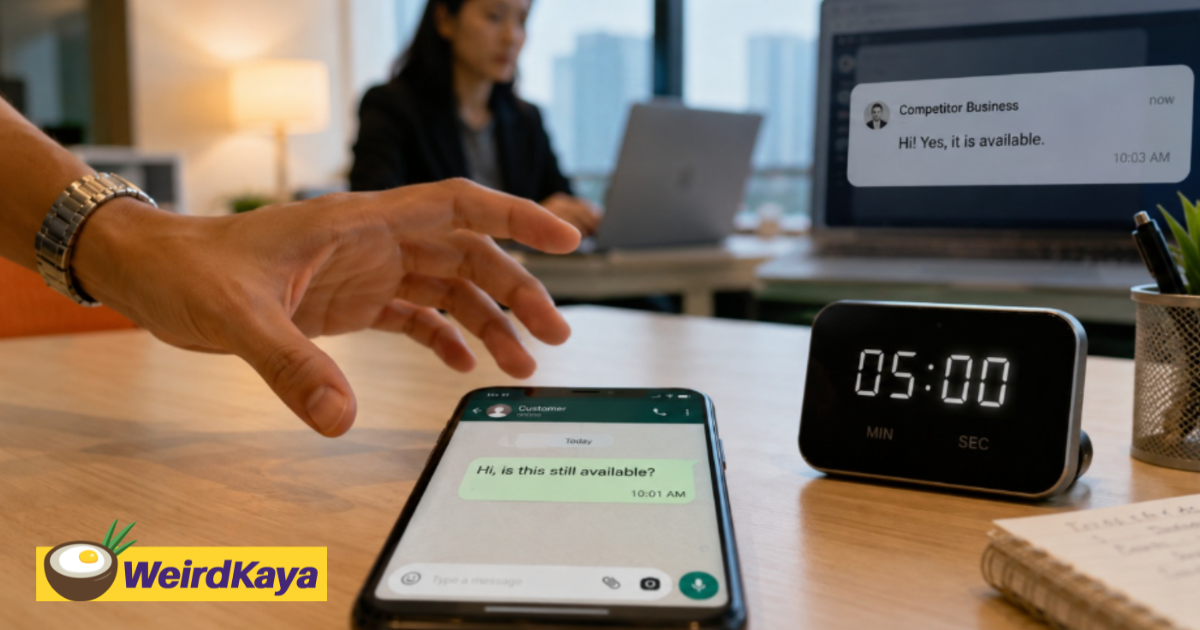
You message a business on WhatsApp to ask about a product. Five minutes pass. Then 30 minutes. Several hours later, there is still no reply.
By then, you have probably contacted another seller.
For customers, it is a minor inconvenience. For businesses, however, that unanswered message could mean a lost sale.
Malaysians prefer messaging businesses
WhatsApp has become part of everyday life in Malaysia.
People use it not only to speak to friends and family, but also to book appointments, arrange test drives, enquire about hotel rooms and check whether a property is still available.
According to DataReportal’s Digital 2026: Malaysia report, 90.7% of Malaysian internet users aged between 16 and 64 use WhatsApp each month.
A 2024 Kantar study commissioned by Meta also found that seven in 10 Malaysians prefer messaging businesses instead of calling or emailing them.
The same proportion said they were more likely to buy from a business they could contact through messaging.
For many consumers, messaging is no longer an extra customer service option. It is the first place they go when they are ready to make an enquiry.
Yet many businesses continue to treat these messages as something that can wait.
Why the first five minutes matter

A customer who sends a message is often interested at that exact moment. They may be comparing prices, checking availability or deciding which business to visit.
That interest, however, can disappear quickly.
A lead response study conducted by Dr James Oldroyd and InsideSales.com analysed more than 15,000 leads and over 100,000 call attempts.
It found that businesses responding within five minutes were 21 times more likely to qualify a lead than those waiting 30 minutes.
The odds of successfully contacting the person were also 100 times higher within that five-minute window.
The research was conducted in 2007, long before messaging apps became the norm.
While consumer habits have changed since then, the study highlights a principle that remains relevant today: the longer a business waits, the colder the lead becomes.
On WhatsApp, customers are used to conversations happening almost instantly.
A reply on the next working day may be reasonable from the business’s perspective, but the customer could have already moved on.
The business that replies first may not always offer the cheapest product or have the biggest sales team. Sometimes, it simply reaches the customer while they are still interested.
Small teams cannot monitor every inbox
Responding within five minutes sounds straightforward until a business begins receiving enquiries from multiple channels.
A small team may need to monitor WhatsApp, Instagram, Facebook, email and website forms at the same time.
Messages can also arrive after working hours, during weekends or while employees are assisting other customers.
Hiring enough people to watch every channel around the clock is not realistic for many small and medium enterprises.
This is where AI-assisted lead response tools are beginning to play a bigger role.
Using AI to start the conversation

Instead of replacing salespeople, these tools can act as the first point of contact.
They monitor incoming enquiries, provide immediate responses and ask basic questions to understand what the customer needs.
Once the lead has been qualified, the conversation can be passed to a human salesperson who takes over from there.
One example is OutPerform, a Malaysia-based platform which says it is used by more than 1,000 organisations across the region.
The platform combines AI-assisted outreach with lead management tools and native WhatsApp support.
This allows businesses to start conversations with potential customers without requiring them to download another app or move to a different channel.
Its goal is to qualify an enquiry as soon as it arrives before handing the warmer, sales-ready conversation to a human representative.
Such systems are increasingly relevant in industries where customers commonly compare several providers at once, including property, automotive, hospitality and education.
In these sectors, replying faster can determine which business gets the customer’s attention first.
Is your business responding quickly enough?
Business owners can begin by checking three things.
First, identify where most enquiries come from. If customers mainly contact the business through WhatsApp or social media, a conventional customer relationship management system may not be monitoring the channels that matter most.
Second, measure the actual response time. Send an enquiry to the business and see how long it takes for someone to reply. The result may be very different from what the team assumes.
Finally, examine how employees spend their time. If salespeople are repeatedly answering the same basic questions, AI tools may be able to handle the initial qualification while the team focuses on more valuable conversations and closing sales.
The aim is not to remove the human element. Customers still value empathy, judgment and personalised assistance, especially before making a major purchase.
The more effective approach is to combine both sides: technology provides the immediate response, while people build trust and complete the sale.
As more Malaysians turn to messaging apps as their first point of contact, businesses still relying on “we’ll get back to you later” may be losing customers without even realising it.
Sometimes, the difference between winning and losing a customer is not the product or the price. It is simply who replies first.
Sources: DataReportal’s Digital 2026: Malaysia, The Malaysian Reserve’s report on Kantar and Meta’s research, and the Lead Response Management Study.