
Not financial advice. This article is based on court findings, the founder’s own public admissions, parliamentary replies and news reports. The MACC investigation into KWAP’s investment is ongoing, and no wrongdoing by any Malaysian party has been established.
Some scandals are boring. Numbers, acronyms, a press release, done. This one is not.
The eFishery saga has everything: a rags-to-riches founder, a single desperate night in front of an Excel sheet, six years of lies, some of the smartest money on Earth getting played, and a Malaysian pension fund holding part of the bill.
Now that the MACC has stepped in, let us tell you the whole story from the beginning.
Chapter 1: The Catfish Kid
Gibran Huzaifah did not come from a background of wealth. As a biology student at Institut Teknologi Bandung, he rented a fishpond and bred catfish to pay his own university fees, which was something he was really good at.

By the time he graduated in 2012, he was managing 76 rented ponds and had learned the two problems that squeezed every small fish farmer: feed costs eat your margins, and middlemen control your market.
So in October 2013, he founded eFishery in Bandung to fix both.
The core product was a smart feeder: an internet-connected device that dispenses exactly the right amount of feed at the right time, because fish only need about 4% of their body mass in feed daily, and overfeeding is pure wasted money sinking to the bottom of the pond.

Around the hardware, he built a whole ecosystem: feed supply, financing for farmers, and market access that cut out the middlemen.
Why the story sold so well
Most Southeast Asian unicorns were apps for city people: ride-hailing, delivery, e-commerce. eFishery was different. Real hardware, rural farmers, food security, a founder who literally slept next to fishponds. Investors were not just buying a business; they were buying a beautiful story.
Chapter 2: The Night The Numbers Changed
In late 2018, eFishery turned five years old, had about 100 employees, and was three months away from running out of cash.
According to the detailed account Gibran later gave Bloomberg News, he sat alone in front of a financial report on his laptop and started typing in numbers that were not real.
Within an hour, the struggling company looked like a winner on paper. He sent the file to investors, convinced someone would catch the lie.

Nobody did. Instead, his backers were encouraged by the “improving” business and put in more money, which kept the company alive. “I thought I would just do it to survive,” he later admitted.
And that is how a one-night act of desperation hardened into a permanent system: two sets of books: a real one for a small inner circle, and an inflated one for investors, banks and auditors.
The scheme ran under the noses of investors for six years.
Chapter 3: The Unicorn Machine & KWAP’s Entry
Fuelled by fake growth, eFishery became the crown jewel of Indonesian agritech. Gibran publicly claimed the company had been profitable since 2018, the exact year the fakery began.
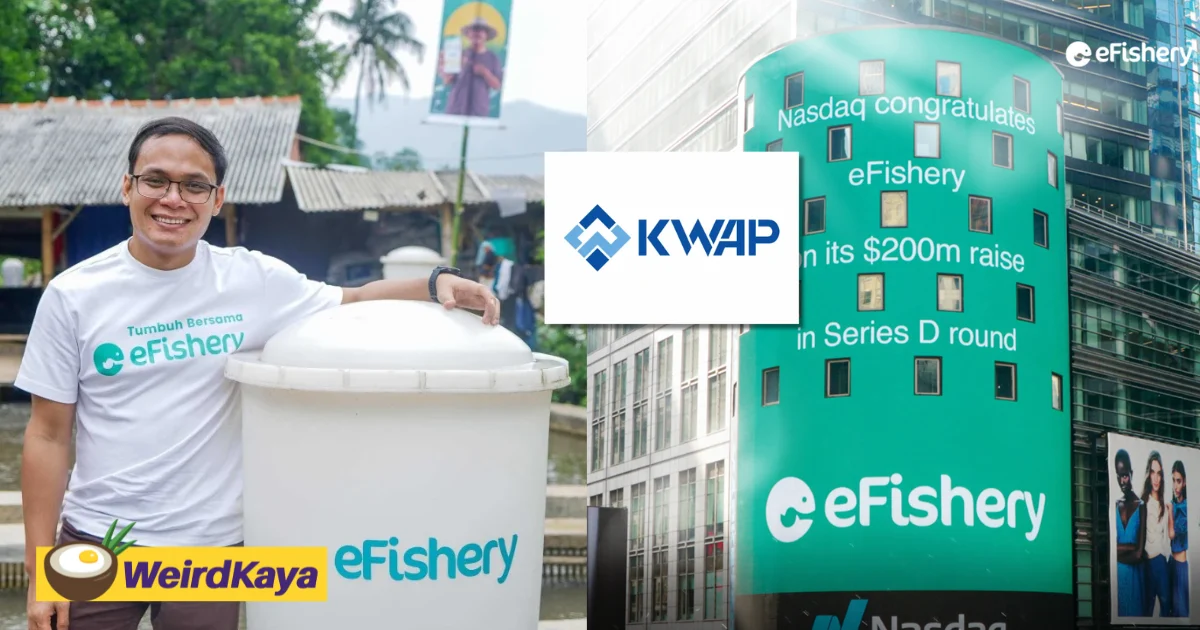
The fundraising ladder climbed fast: US$90 million in early 2022, then the big one in May 2023, a US$200 million Series D that valued the company at around US$1.4 billion.

Goldman Sachs advised on the deal. PwC and Grant Thornton served as auditors. The cap table read like a sovereign wealth reunion: SoftBank Vision Fund 2, Temasek, Northstar, Abu Dhabi’s 42XFund, Peak XV, 500 Global.
And in July 2023, Malaysia’s KWAP joined in.
KWAP is Kumpulan Wang Persaraan, the pension fund for Malaysian civil servants. Headlines later put its investment at US$47.7 million, roughly RM200 million, based on DealStreetAsia’s reporting.
KWAP has since clarified the actual figure: RM163.4 million.
KWAP’s total investment in eFishery amounted to RM163.4 million, representing approximately 2.51% of the company’s total shareholding.
“KWAP was a minority shareholder, while the majority of the company’s shares were held by other investors, including major global institutional investors that were similarly affected by the misconduct,” it said in a statement.
Chapter 4: The Whistleblower & Unravelling
In December 2024, a whistleblower report landed with investors.
An investigation began, Gibran and his Chief Product Officer were suspended, and FTI Consulting was brought in to dig through the books.
In January 2025, FTI’s 52-page draft report leaked to the press, and the world finally saw the real numbers next to the fake ones.
| Jan-Sep 2024 | What Investors Were Told | Reality |
|---|---|---|
| Revenue | US$752 million | US$157 million |
| Bottom line | US$16 million profit | US$35.4 million loss |
| Smart feeders deployed | 400,000 units | ~24,000 units |
In a nutshell, revenue was inflated by roughly US$595 million in nine months, nearly five times what one can achieve in reality.
Even the feeders, the physical devices you could theoretically go and count in ponds, were exaggerated by more than sixteen fold.
By February 2025, investors were reportedly looking at recovering less than 10% of their capital, DealStreetAsia reported.
Roughly US$415 million had been raised from investors over the years, and the collapse is widely described as a US$300 million scandal.

FTI Consulting took over as acting management, and the company that once claimed to be the world’s largest aquaculture player was eventually wound down.
Chapter 5: Confession & Verdict
In April 2025, Gibran did something rare for a fraud suspect: he gave Bloomberg a five-hour interview and admitted everything, essentially describing how the deception started and how it snowballed beyond his control.
Four months later, Indonesian police detained him along with two other former executives.
On 29 April 2026, the Bandung District Court, in the same city where he once rented his first fishpond, found him guilty of embezzlement and money laundering.
He was sentenced to nine years in prison, plus a fine of one billion rupiah. Two other ex-managers were convicted alongside him.
Malaysian aftermath
In July 2026, the story crossed the Strait of Melaka, with the Finance Ministry telling Parliament in a written reply to Subang MP Wong Chen that KWAP had been the victim of a well-planned, orchestrated fraud.
Prime Minister Anwar Ibrahim, who is also Finance Minister, stressed that KWAP and the wider consortium had done proper due diligence and were now pursuing legal action and fund recovery, alongside internal governance reviews.
On July 17, the MACC formed an investigation team, announcing the probe publicly on July 18, the same day KWAP clarified its exposure was RM163.4 million rather than RM200 million stated in headlines.
The MACC probe is into the investment loss itself; no individual at KWAP has been accused of wrongdoing. And RM163.4 million, while painful, is a small fraction of KWAP’s fund, which runs into the hundreds of billions. Nobody’s pension is at risk from this single deal.
READ ALSO: