

A Malaysian user on Xiaohongshu recently sparked a discussion after asking whether Malaysians travelling to Japan should wear a Malaysia flag pin to avoid being mistaken for tourists from China.
This comes as both countries are currently experiencing strained political ties.
The post featured a Shopee listing selling “Lencana 2025 Jalur Gemilang” pins, along with a caption that read:
Going to Japan soon. Malaysian friends, do we really need this?”
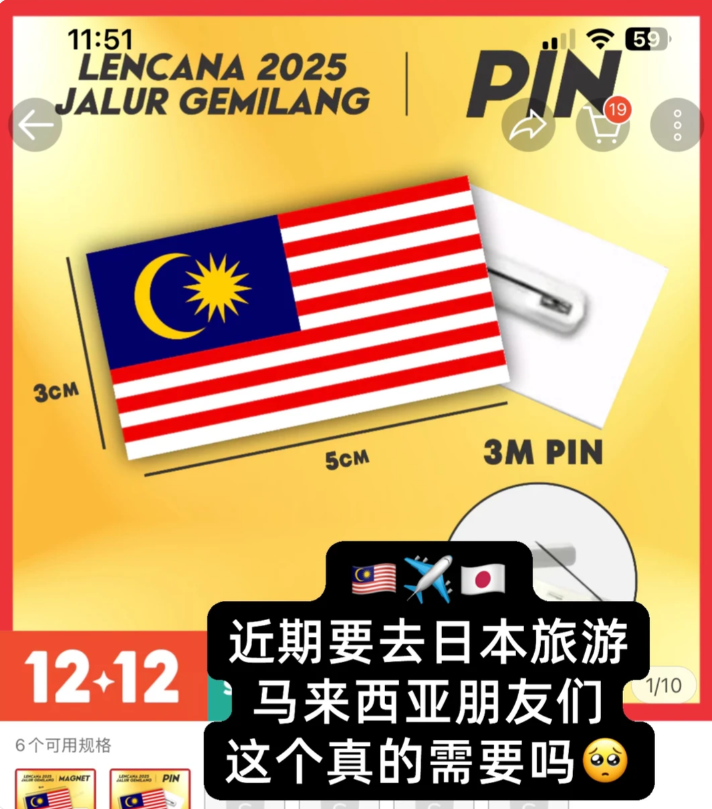
The question quickly resonated with other Malaysians online, especially ethnic Chinese Malaysians who share similar appearance and language with tourists from China, prompting concerns over whether geopolitical tensions could influence how they are perceived abroad.
In the comment section, several Malaysians shared their own encounters in Japan, mentioning that locals sometimes assume they are from China and respond cautiously or coldly due to current political sensitivities.
One commenter said:
If you accidentally say something in Mandarin, some people might react differently. It just happened to me recently.”
These comments fueled the debate over whether wearing a Jalur Gemilang pin could help Malaysians immediately signal their nationality and avoid unnecessary awkwardness.
Flag pins trending online
The rising discussions and attention around Malaysia-flag pins on Shopee and Xiaohongshu show that more travellers are considering whether a small national identifier could help them avoid misunderstandings abroad.
Many Malaysians say they use the pin on backpacks, jackets or lanyards when travelling, not only for safety but also out of national pride.
Others argued that most Japanese people do not generalise or treat foreigners differently but acknowledged that a visible national identifier could help prevent misunderstandings in the rare cases where geopolitical tensions spill over into everyday interactions.
‘I don’t think nationality is an issue’
Speaking to WeirdKaya, a Malaysian named Jason who travelled to Japan right after China announced that its citizens should avoid travelling to Japan, said he did not face any issues during his trip.
He faced no hostility from locals, despite rising online concerns about how Mandarin-speaking tourists might be perceived amid China–Japan political tensions.
He told us that during his 15-day trip across Osaka, Kyoto, Tokyo and Fuji, every interaction with Japanese staff and residents was polite and welcoming.
Everyone was very friendly. I wasn’t treated unkindly at all,” he said.
He also noticed a sharp decline in mainland Chinese tourists compared to his visit last year in the same season. This time, the Mandarin speakers he encountered were more evenly split between Taiwanese, Malaysians and Chinese visitors.
He believes respectful behaviour matters far more than nationality when it comes to how foreigners are treated in Japan.
“As long as you follow local norms, keep quiet on public transport, don’t litter, don’t eat while walking, and use English or a translation app, there’s no issue. If you act civilly, you’ll be treated the same way,” he added.
On whether Malaysians should wear a Malaysia-flag pin to avoid being mistaken for tourists from China, he feels the worry is overstated.
“In real-life travel, the pin is more of a decoration than something you actually need,” he said, noting that while some service workers may show brief caution upon hearing Mandarin, they become friendly once communication is clear.
He concluded that Japan remains warm and welcoming, regardless of geopolitical tension playing out in real time.