

Malaysia has once again overtaken China in terms of GDP per capita, emerging as one of Asia’s higher-income economies and securing the 8th spot in the region according to the latest estimates.
This marks a notable shift in economic rankings and highlights Malaysia’s ongoing development trajectory.
According to World Bank data, China’s GDP per capita in 2024 was approximately USD 13,303, while Malaysia’s stood at USD 11,874 — meaning China maintained a lead in per-person income last year.
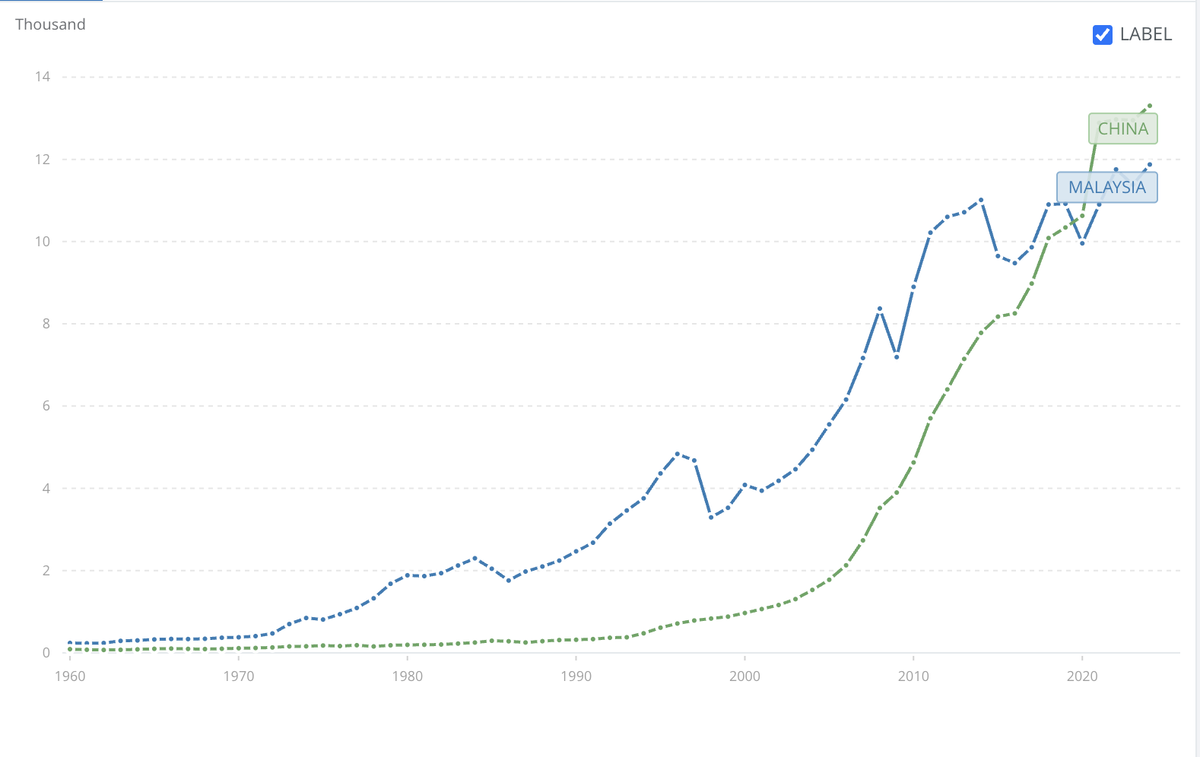
China’s per-capita GDP had overtaken Malaysia’s in 2021 as its rapid economic growth outpaced Malaysia’s.
However, Newsweek reported that 2025 projections based on International Monetary Fund estimates indicate Malaysia’s GDP per capita is expected to reach about USD13,900 — slightly above China’s USD13,806 — allowing Malaysia to reclaim the lead in this metric.

This update places Malaysia ahead of China in nominal per-person GDP, contributing to its ranking as 8th among Asian economies in per-capita income.
Newsweek notes that countries such as Singapore, Macau, Hong Kong, Taiwan, South Korea, Japan and Brunei rank above Malaysia, reflecting a diverse spread of economic performance across the region.
What this means
GDP per capita measures the average economic output per person and is a common way to compare living standards across countries.
Although China still remains a larger economy in total GDP terms, Malaysia’s stronger gains in per-person output reflect factors such as solid services and manufacturing performance, alongside demographic trends.
Ringgit strengthens on back of economic confidence
Malaysia’s economic achievements this year have been mirrored in the performance of the Malaysian ringgit (RM), which has strengthened noticeably against the US dollar and other regional currencies in 2025.

The ringgit has appreciated to around MYR 4.03 per US dollar, marking some of its strongest levels in nearly five years and reflecting improved investor confidence in Malaysia’s macroeconomic fundamentals.
Analysts attribute the strengthening to solid export performance, structural reforms, and a weaker US dollar backdrop.
Over the course of 2025, the ringgit has risen by about 8–9 percent against the US dollar — outpacing many of its Asian peers — with gains also observed versus currencies such as the Indonesian rupiah and Japanese yen.