
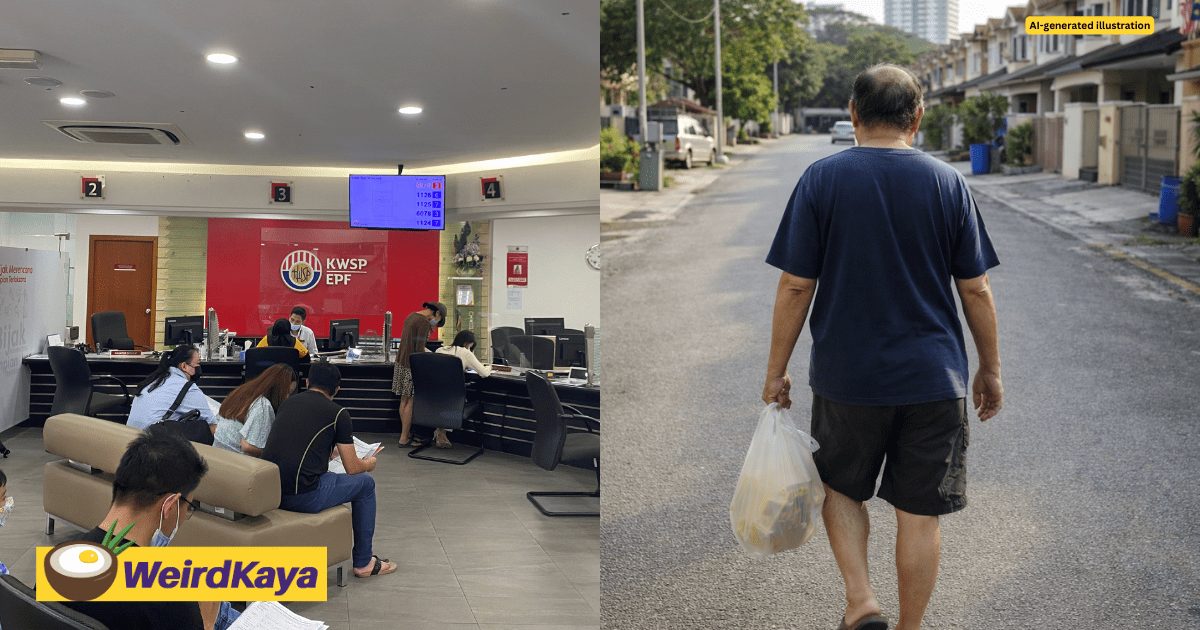
A Malaysian netizen took to Reddit to ask whether his 55-year-old uncle could realistically retire with RM500,000 in Employees Provident Fund (EPF) savings and no other financial buffer.
According to the post, the uncle is single and lives alone in Puchong. He owns a two-room apartment and drives a Perodua Myvi, but does not have additional savings or investments.
The netizen added that his uncle is feeling physically and mentally exhausted due to health issues and no longer wishes to continue working.
However, the uncle is also concerned about how long his EPF savings would last if he stops working entirely.

RM500,000 is “not as low as it sounds,” say netizens
Many Redditors responded by pointing out that RM500,000 in EPF already places the man among the higher-ranked savers in Malaysia.
Assuming his apartment and car are fully paid off and he has no dependents, several users said his financial position may be more stable than he fears.

Some commenters noted that retirement struggles often stem from large discretionary spending such as children’s weddings, home renovations or frequent travel, expenses that do not appear to apply in this case.
Living off EPF dividends could be feasible
Several users broke down the numbers, estimating that if EPF dividends average between 5% and 6% annually, RM500,000 could generate about RM25,000 to RM30,000 a year.
This translates to roughly RM2,000 to RM2,500 per month.

According to some Redditors, this could be sufficient for a modest lifestyle if the uncle avoids dipping into his principal savings.
Others added that keeping monthly expenses within RM1,500 to RM2,000, covering essentials such as food, utilities, internet and basic transportation, would make retirement more sustainable for a single individual.

Healthcare and rising costs remain key concerns
Not all responses were optimistic.
Some users cautioned that healthcare expenses could increase significantly with age, particularly as the uncle reportedly has high blood pressure and requires long-term medication.
Inflation, home maintenance and eventual vehicle replacement were also cited as costs that could gradually erode his savings.
To reduce medical expenses, several commenters suggested relying on government hospitals and clinics, which remain considerably cheaper than private healthcare options.

The discussion also raised questions about whether the uncle should withdraw his EPF savings to invest elsewhere.
While some mentioned fixed deposits, ASB or unit trusts, many argued that EPF has historically delivered stable returns and that liquidity concerns are less pressing after age 55.
Several commenters also warned against lending money to relatives or friends, noting that such requests can quickly deplete retirement funds.