Exclusive Story by WeirdKaya – Proper accreditation to WeirdKaya and consent from the interviewee are required.
For most of us, home is filled with sounds, like conversations, TV noise, or parents calling from another room.
For 19-year-old Muhammad Nabil, home was entirely different, with him describing it as such:
For me, silence was never quiet.”
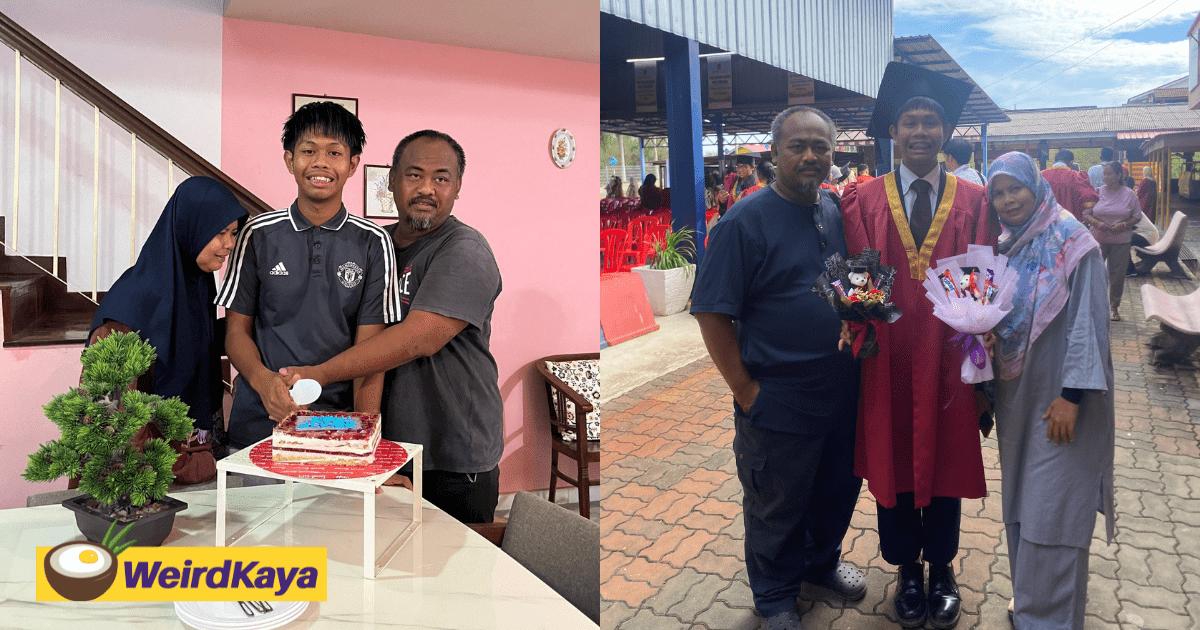
Born to deaf and mute parents, Nabil grew up in a world where hands spoke louder than voices and facial expressions carried entire conversations.

Today, he is a Certified Sign Language Interpreter, a TikTok creator translating songs into sign language, and the bridge between his parents and a world that often doesn’t understand them.
Picking up sign language before speech
Nabil’s father was deaf from birth, while his mother lost her hearing after a high fever during her childhood years. When Nabil was born, his parents even thought he might be deaf too.
“They tested me by putting me in front of the TV to see if I’d react to sound,” he laughed. “That’s how they found out I could hear.”
But by then, BIM (Bahasa Isyarat Malaysia) had already become his first language.
I don’t remember my first sign language lesson. BIM was just how I told my mom I was hungry. It came naturally.”

Ironically, Nabil only discovered he had a voice when he started kindergarten.
When I entered school, I suddenly realised I could use my voice outside. I must’ve picked it up from my aunts or adults around me.
At home, there was no divide between the deaf and hearing world. To me, I just tune into whatever environment I’m in.”
Being the ‘bridge’
For over 16 years, Nabil has been the main communication bridge for his parents at shops, offices, daily errands, and eventually their Abang Cendol stall.
Nabil was rather forthcoming when asked about his “growing up” period, saying there wasn’t a particular moment he remembers vividly.
I’ve been helping them my whole life. I do it willingly with sincerity. I don’t view it as a burden.
My parents needed a bridge to navigate a world that doesn’t always understand them. I know they need me, and that’s enough.”
Still, he admits he sometimes wonders what a “normal” childhood could have been.
The thought has crossed my mind. But I’ve learned to divide my time and still lived my life like any ordinary kid. Whenever my parents needed me, I was there. Period.”
“In return, the depth of our communication is special. Even without sounds, I can video call my parents and still feel completely connected,” he said.
People often assume deaf households are quiet, but that couldn’t be further from the truth.

“When my dad is angry, the neighbours can definitely hear him,” Nabil joked. “Even without words, they have ‘voices’.
Love and anger are seen through the face and hands. Our expressions are raw and emotional. It’s a language built not just on hands, but on hearts, too.”
Protecting his parents in a hearing world
After class every day, Nabil goes to his parents’ cendol stall as he refuses to stay in a hostel even at his parents’ insistence.
I worry about them. I want them to be independent, but I also want to be there if communication breaks down.”
“Sometimes, customers don’t realise my parents are deaf and will get impatient. It hurts to see them being treated like this.

But I don’t get angry because customers aren’t aware of it. So I’d just explain politely and once they understand, their reaction changes to curiosity or respect.”
However, Nabil also adds that there were many harsher moments, like watching his parents being dismissed at counters or government offices.
Even when staff knew they were deaf, the service remained poor. While it made me angry and sad, I had to stay patient to resolve it for them.”
Getting certified
In 2022, Nabil became an official interpreter with the Melaka Deaf Association, which was attributed to an unexpected moment.
“During a government meeting, there was no interpreter available. I just stepped in, and that’s when I realised I could do it,” he recounted.
Even as a Child of Deaf Adults (CODA), I had to attend classes. Home signs are different, and most CODAs can only use sign language with their parents.
For me, I wanted to speak to the entire Deaf community.”

Nabil says his parents were the ones who encouraged him to become an interpreter and not just keep this talent to himself.
Sign language is very emotional. It’s not just about the hands but also about facial expressions. Everything must come together.”
As for his TikTok journey, Nabil said it started out merely for fun, and he never expected his sign-singing videos to build a following.
“The first song I signed was ‘Untuk Mencintaimu’. At first, I only showed my hands as my goal wasn’t to teach hearing people sign language. I did it so the Deaf community can feel the vibe and rhythm through expressions and movement.
Today, many deaf individuals thank me for spreading awareness, and it keeps me motivated.”
Not unlucky, just different
People have told Nabil he’s lucky to be able to hear, but he doesn’t agree.
Being deaf isn’t abnormal. My parents can drive, work, and live a normal life. They’re just different in how they communicate.
“To me, the hearing world is on equal footing as the deaf world, and I’m happy to talk to hearing individuals as well as sign with the Deaf community.”
However, Nabil wishes more people would learn to understand deaf culture.
Our facial expressions are part of our ‘grammar’. Sometimes people think we’re angry when we’re merely joking.”
“One of the things that irks me the most is when people make random hand signs and joke about it being ‘gang signs’; it’s disrespectful. That’s our language. How would you feel if someone mocked your language?”

Nabil also believes the biggest misconception is that little people learn sign language.
This language barrier limits career opportunities for deaf individuals. Many have potential, but without communication access, they’re forced into small businesses just to survive.
“I want to see deaf people working in professional fields. Their dreams shouldn’t be blocked by a lack of interpreters or understanding.”
When asked what he does whenever he feels drained, Nabil said he turns to the same people he protects.
I talk to my parents. They help me recharge. And I’m pretty sure my younger self would be proud of how far I’ve come.”
If Nabil could send one message to the hearing world:
Learn sign language properly. Treat the Deaf community with dignity. To my parents, be patient. Perhaps one day, the world will finally understand us.”
Exclusive Story by WeirdKaya – If you wish to reproduce this story, please ensure that you obtain consent from the interviewee to maintain factual accuracy and avoid the potential spread of misleading information.

If referencing or using any information from our story, we kindly ask that proper credit is given, along with a backlink to WeirdKaya, as acknowledgment of the efforts made by our editors in sourcing and conducting interviews.
Read more: